
Underneath it all: an exhibit
Friday, October 5, 2012
NYC!!!


Sunday, August 26, 2012
Bye Minneapolis!
We would like to thank all of the wonderful people at the Textile Center who helped install, promote, support and host our work. We especially wish to thank Sheryl for all of her hard work and patience. Without her help and guidance, this exhibit would not have looked so beautiful and so impressive.
Our next venue will be in Flagstaff, Arizona in the beginning of 2013. We will be posting information about upcoming news.
Tuesday, July 24, 2012
Textile Center Opening, July 20



Friday, July 13, 2012
New Work
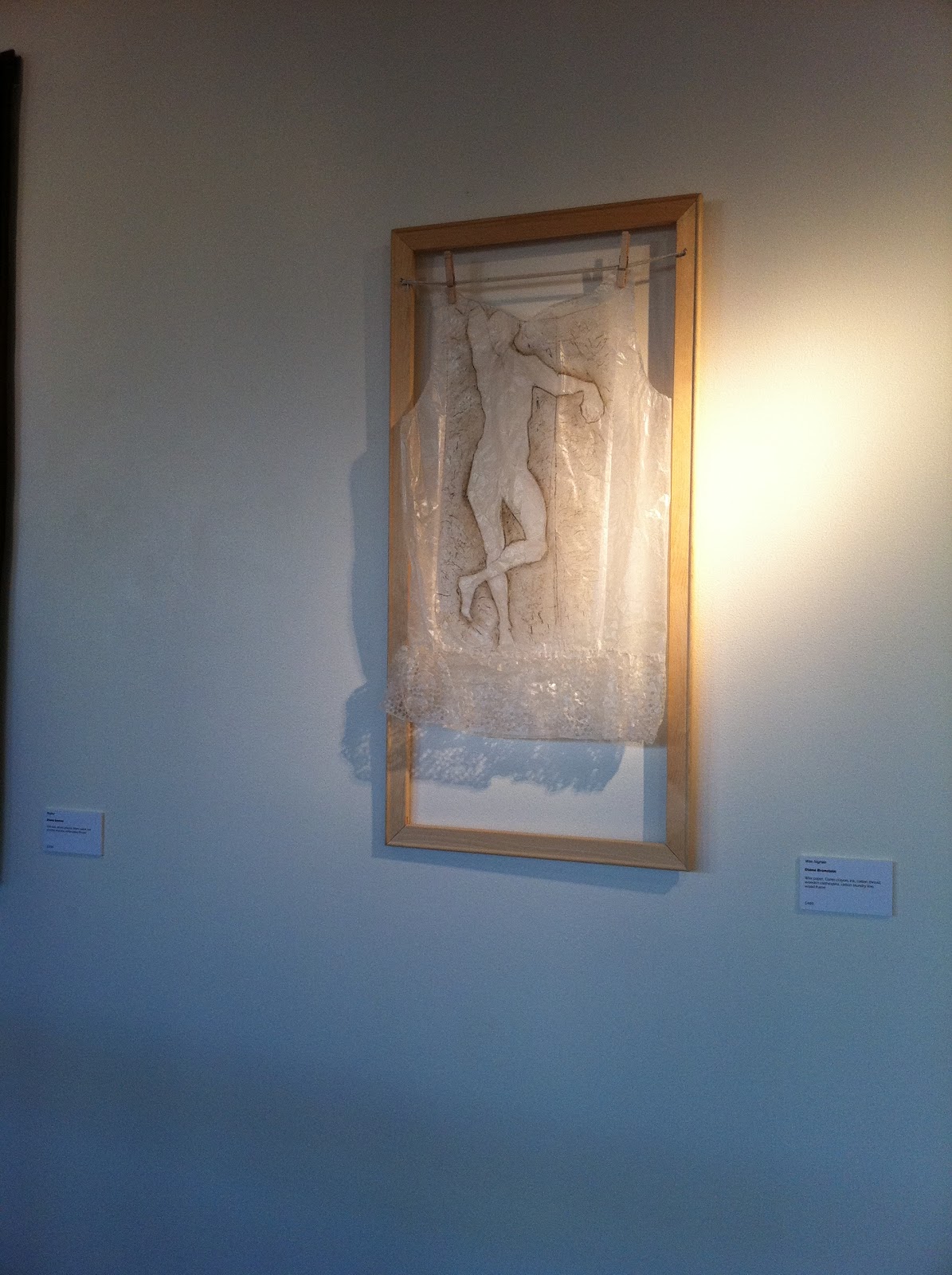
These pieces have never been shown in any other gallery or exhibit. Look for photos on our blogsite and on Facebook. And if you find yourself in Minneapolis-stop by and see the show!
Underneath it all: Desire, power, memory & lingerie opens at the Textile Center, 3000 University Avenue, S.E. in Minneapolis on July 20 and runs through August 24th.
Thursday, July 12, 2012
Minneapolis-here we come!
Here is a link to their website.
http://www.textilecentermn.org/gallery.asp
More next week...
Monday, May 21, 2012
Three artists in History of Woman
The show opens on May 30th and runs through June 28th.
Congratulations!
Thursday, April 12, 2012
In the news...
Saturday, April 7, 2012
Two new venues!
Sunday, March 11, 2012
Laura Ann Jacobs in the news

Laura Ann that is receiving recognition in The Huffington Post and Juxtapoz for her beautiful (and satirical) pieces. Click here to read the article about Laura Ann's amazing work.
Diane Savona at Fiber Philadelphia

Diane has been very busy at Fiber Philadelphia which opened last weekend. In addition to curating a show titled Mending=Art, she has a gorgeous piece in the Outside/Inside the Box which is featured on the slide show for the Fiber Philadelphia website.
Miriam at the Printed Book in NOLA
Saturday, March 10, 2012
Our artists: April Dauscha

April Dauscha's series Exposed: An Armory of Physical Longings investigates the idea of body armor. The corsets are part of an imaginary wardrobe that serves to protect and accommodate women in their body processes and their mental states. They are uniforms that provide strength and empowerment. They speak of her desires and struggles. They seek beauty in her burdens. April Dauscha is currently a graduate student at Virginia Commonwealth University studying Fiber in the Craft/Material Studies Department. She looks towards Costume History, traditional Catholic rituals, and themes in 19th century literature to feed her obsession with ritual, reconciliation and communication through dress.
Monday, December 19, 2011
Our artists: Erica Spitzer Rasmussen

Erica Spitzer Rasmussen creates amazing clothing from organic materials, like dried tomatoes, fish skin, hair and manufactured materials like Bandaids, and fortunes from Chinese fortune cookies. Her pieces are powerful, yet delicate. She makes handmade paper which she uses as a base for her pieces, adorning them with multiple items.
She writes, "I use clothing as subject matter because it provides me a ground on which to investigate identity and corporeality. My garments are metaphors. They can encompass narrative qualities, illustrate and dissolve bodily fears, or act as talismanic devices.
In addition to utilizing handmade paper, I often incorporate non-archival media into my work. I derive great joy from transforming everyday materials into something personal, meaningful and beautiful. When I see tomato paste, dog hair, sausage casings, spent tea bags or dried fish skins, I envision a work that may be transitory in nature, but rich in surfaces."
Erica teaches studio arts as an Associate Professor at Metropolitan State University (St. Paul, MN).Our artists: Ingrid Goldbloom Bloch

Ingrid Goldbloom Bloch's fantastic undergarments take the idea of lingerie into a new realm. She weaves utilitarian materials: aluminum strips from cans, dryer parts, rivets, and other metal odds and ends into life-sized bras, undies and garter belts. She incorporates the rich colors and shiny nature of these materials into stunning pieces which rival any designer style.
She writes, "I love hardware stores. As a little girl, I would accompany my father on his errands and get lost in the aisles imagining all the things I could make from the bits and pieces I came across. Hardware stores are treasure troves of hidden art forms. If one looks beyond an items intended purpose, it can be transformed into something surprising and beautiful. By using ordinary items designed for other purposes to create my art, one is compelled to take a closer look at the materials and see them in a new light.
Trashy Lingerie 1, 2 & 3 are meant to be humorous depictions of women’s undergarments and the pursuit of looking sexy at the expense of comfort."
Our artists: Diane Savona

Diane Savona's pieces merge art with archaeology. Her visually rich pieces are constructed from scraps of other's lives: old fabric, clothing and sewing notions, layered under and over, revealed like the strata of a dig site. In addition to these "Fossil" pieces, she has created a series of "soft-bodied specimens"; old corsets and girdles displayed in Mason jars. It is a witty take on the science of collection and cataloguing.
She writes, "My art is constructed of salvaged linens, found at the local equivalent of archaeological digs-garage sales. Once-common crocheted doilies and embroidered tablecloths are becoming extinct. By presenting them as unearthed fossil specimens, I hope to change viewer perception of our textile heritage."
In 2010, Diane held a one-woman exhibit titled "Closet Archaeology' at the Hermitage Museum in Ho-Ho-Kus, New Jersey. She has exhibited in many fiber arts shows around the country.
Our artists: Amanda N. Simons

Amanda N. Simon's work revolves around our prescribed roles in life. Her paintings incorporate old sewing patterns which add a layer of direction to her outstanding figure work. Amanda confronts the viewer with visual statements of gender and emotion.
"Each of us is born into a blueprint.
Ours lives, in many ways, are defined solely by our adherence to, or deviation from, that blueprint.
As a visual artist, I use the juxtaposition of the human form and the concept of a social blueprint as a metaphor for the constraints of contemporary social expectation. My visual language is a means of exploring, deconstructing, and exposing concepts of gender pre-destiny, gender expectation, and the reciprocal need to challenge those American norms. As an expository commentary on contemporary gender roles and sexuality, my work has served as a cathartic visual autobiography and a challenge to my viewers to deconstruct their own identity on the gender continuum."
Amanda is curently enrolled in the Master of Arts in Visual and Critical Studies at the California College of the Arts in San Francisco.
Our artists: Julie Harris

Julie Harris' artwork creates a bridge between memory and time with her lovely printed handmade papers and clothing. Vintage undergarments, Christening gowns, and school uniforms are the canvases for her printed images. The images range between anatomical, religious and historical, placing in each piece a sense of history and meaning.
Julie currently teaches printmaking and bookmaking at Kean University in New Jersey and has exhibited her work nationally and internationally.
Our artists: Joanne Kaliontzis

Joanne Kaliontzis creates digital collage imagery based on mid-20th century advertising. Iconic campaigns for products such as Maidenform Bras from the 1960s gain new life when a rich palette of color, pattern and repetition is applied. Joanne is a Boston-based graphic designer.
Our artists: Lisa Knox

Lisa Knox's evocative and stark charcoal drawings of old underwear create a powerful sense of history of the owner.
She wrties, "When articles of clothing are unfolded and tacked to the wall, fact and fiction become entwined– the party dress when deprived of its wearer retains a myriad of complex social, psychological and sensory associations. I use clothing to evoke memory, sensation, nostalgia and loss. In as much, a garment is more akin to memento mori than traditional still life. For instance, I look up and see a dress. I look down and paint an artifact, a fossil, a molted transparent shell from another time. Though I analyze the dress as I would an object in a still life, I render the form to evoke the transitory passage of time – knowing that the garments’ owner has grown older and changed. My ultimate hope is that these still life’s and the objects that they represent will retain their charm and give truth to Emerson’s word, “If eyes were made for seeing then beauty is its own excuse for being.”"
Lisa is an oil painter and principle instructor at the Fort Point Studio School which she founded in 2005. For many years her work has focused on still life and portraiture with subject matter ranging from cups to old garments.